 01
01
Primate Forest, Crater-Lake Country
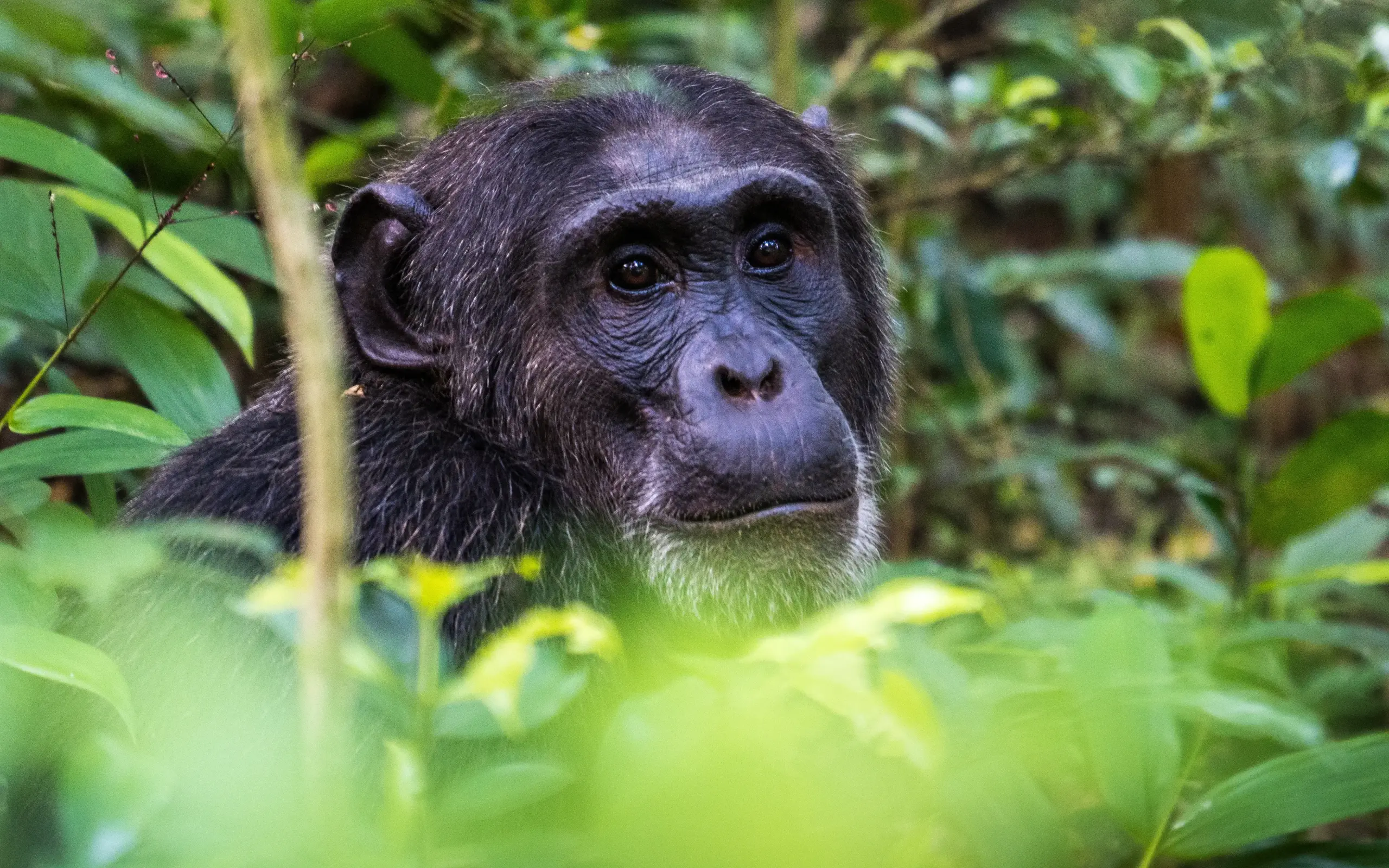
Kibale Forest stands southeast of Fort Portal in western Uganda, a tall block of moist evergreen rainforest holding thirteen primate species. More than 1,000 chimpanzees live here across several habituated communities. Tracking sets out from the Kanyanchu trailhead, and it returns sightings on the great majority of mornings.
Thirteen primate species, a thousand chimpanzees, sightings on most mornings.
Uganda Wildlife Authority guides read fruiting trees, fresh nesting sites and the long-carrying calls that announce a feeding group, then adjust their routes day by day. The forest climbs from 1,100 to 1,600 metres, a band where lowland and montane species overlap, and that overlap is much of the reason the primate list runs so long.
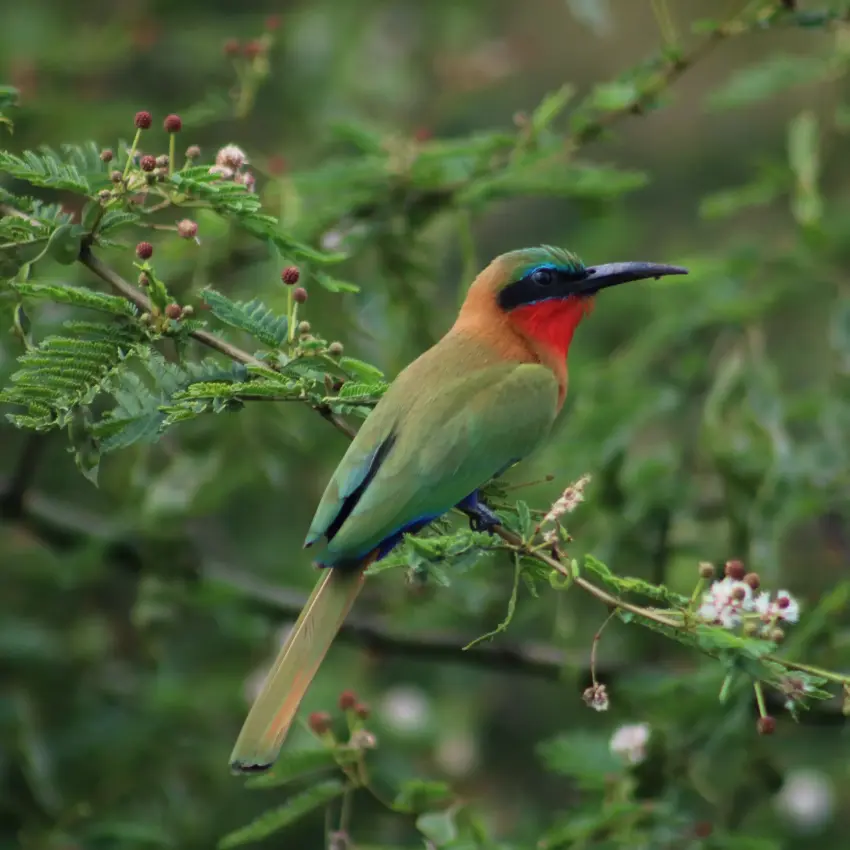
Chimpanzees take top billing, but they share the canopy with a long cast of others. Red and black-and-white colobus, grey-cheeked mangabey, L’Hoest’s, blue and red-tailed monkeys, olive baboons, and nocturnal galagos and pottos all turn up here, the last of them on night walks. Many bird species have been recorded, among them the green-breasted pitta, a target that brings birders to Kibale specifically.
Chimpanzees take top billing, but they share a crowded canopy.
The forest rewards slow walking. Closed-canopy hardwoods, strangler figs, lianas and epiphytes crowd the trail, while a wealth of butterfly species work the light gaps, and that is part of why the chimpanzee communities here are so well understood and the tracking so consistent.
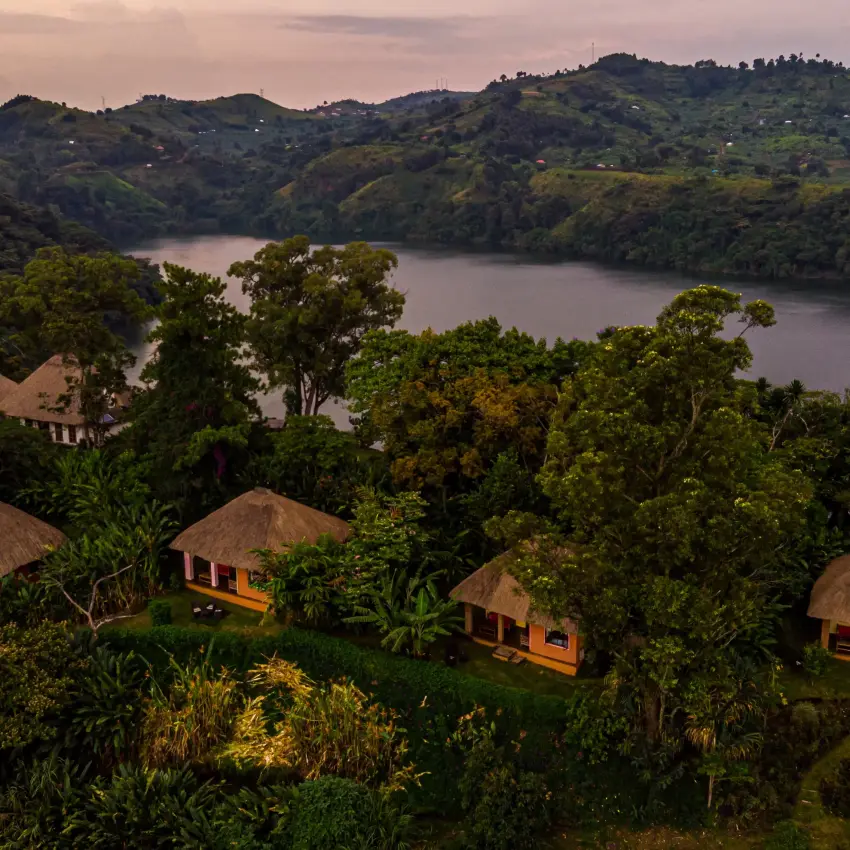
A few kilometres beyond the forest edge, the land buckles into the Ndali-Kasenda crater lakes, a scatter of volcanic basins filled with still water and ringed by tea estates and smallholdings. The contrast gives a Kibale stay real range. A morning spent tracking chimpanzees through dense forest can be followed by an afternoon hiking a crater rim or swimming in one of the lakes, and all of it sits within a short drive of where you began.
Deep rainforest, crater lakes and savanna, all within a short drive of one another.
That variety is the point. Within a compact area sit deep rainforest, papyrus swamp, crater country and farmland, with savannah game a short transfer south. Birders walk the Bigodi wetland outside the park for papyrus species, then return to the forest for hornbills and pittas. Few areas pack so many habitats into so small a radius, and few reward an unhurried itinerary so well.
The surrounding land belongs to Batooro and Bakiga farming communities, working banana, coffee and tea on the forest fringe. Village walks and the Bigodi wetland, managed by a local community association, draw visitors into the wider landscape rather than confining them to the trail. Kibale was first gazetted in 1932 and became a national park in 1993, and its once-logged sections are now well into recovery.
A continuous forest corridor links Kibale to the northern sector of Queen Elizabeth National Park, a roughly 180-kilometre route that forest elephants use to move between the two. That connectivity, set alongside the long-term primate research at the Makerere University field station, is why this forest has held its integrity while farmland pressed in around it. The mix of high-value tracking and sustained science keeps the chimpanzee communities findable year after year.

The best time to visit Kibale Forest
Jan
Feb
Mar
Apr
May
Jun
Jul
Aug
Sep
Oct
Nov
Dec
Recommended
Transitional
Challenging conditions
Chimp sightings run above ninety per cent every month, so the two dry windows, December to February and June to August, are about firmer trails rather than the odds. The wet months keep chimps feeding near the trailheads and are strongest for forest birding, with far fewer visitors, though April and the September to November stretch are the muddiest underfoot.
accommodation in kibale forest
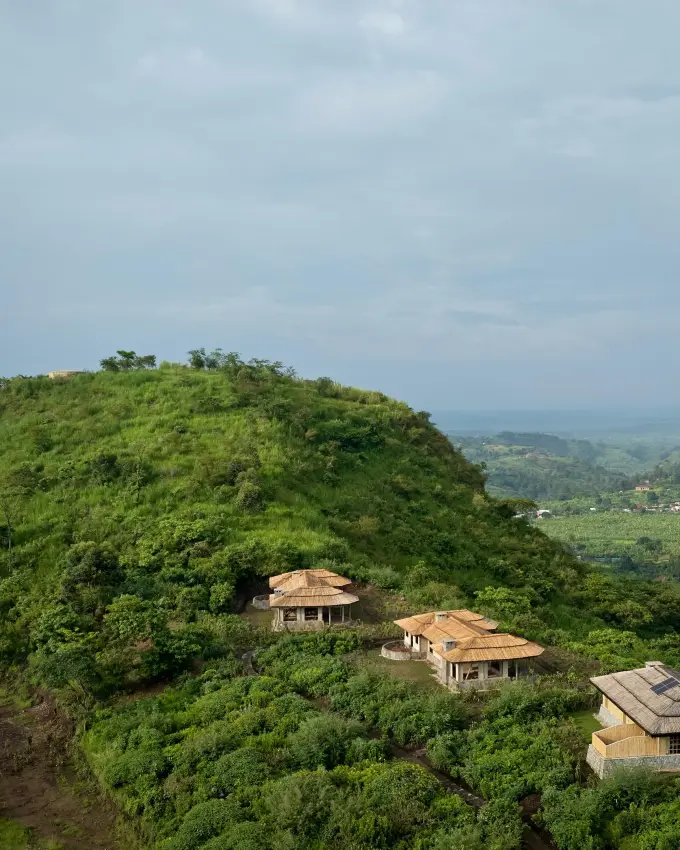
The choice clusters on the park's edges and across the crater-lake country rather than within the forest itself. Options run from high-end lodges set on hills above the trees or overlooking crater basins, to permanent tented camps on the forest fringe and smaller boutique inns near Fort Portal. Most sit close to the Kanyanchu tracking start and the crater trails. Exclusive-use arrangements suit families or groups wanting the run of a single lodge.


activities
Track Chimpanzees and Crater Lakes
Ranger-led chimpanzee tracking and the extended habituation experience run from Kanyanchu within the park, alongside guided forest walks and birding at Kanyanchu and Sebitoli. Off-trail walking is not permitted. Beyond the boundary, crater-lake hikes, swimming, Bigodi wetland birding and village visits fill out a varied stay.

conservation
Research, Snare Removal, Community Income
Uganda Wildlife Authority manages anti-poaching patrols and permits, while Makerere University's field station drives long-term primate research. The Ngogo Chimpanzee Project combines study with snare removal, and KAFRED channels Bigodi wetland tourism into community development. Face the Future has supported forest restoration in degraded sectors.

getting around
Charter Flights via Kasese
Scheduled and charter flights run from Entebbe to Kasese airstrip in around an hour, followed by a road transfer of roughly two hours to the park. Charter flights to Fort Portal are also possible, with lodge helipads allowing helicopter transfers for those wanting to compress the drive. By road, Kampala to Kibale is about six hours on tarmac via Fort Portal.
other areas in uganda
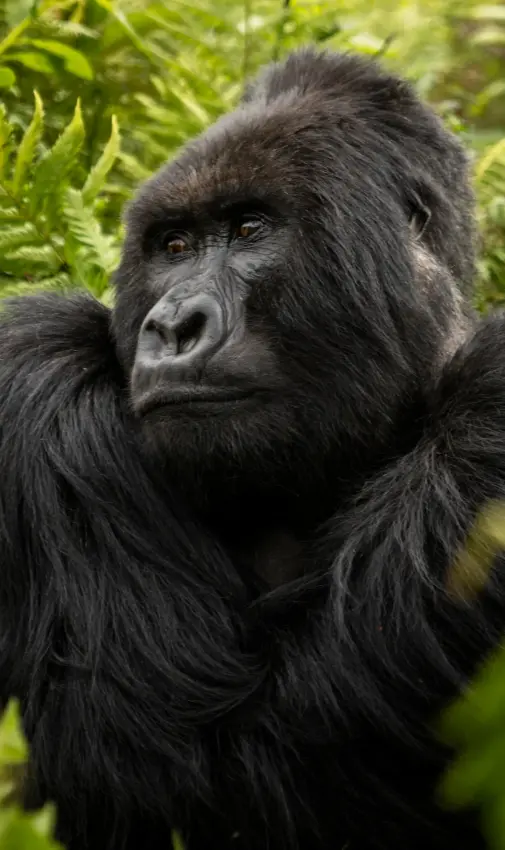
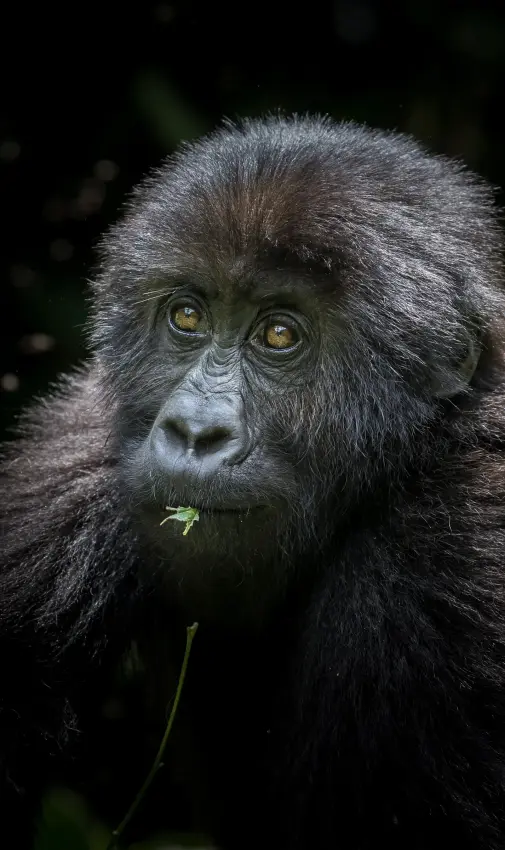
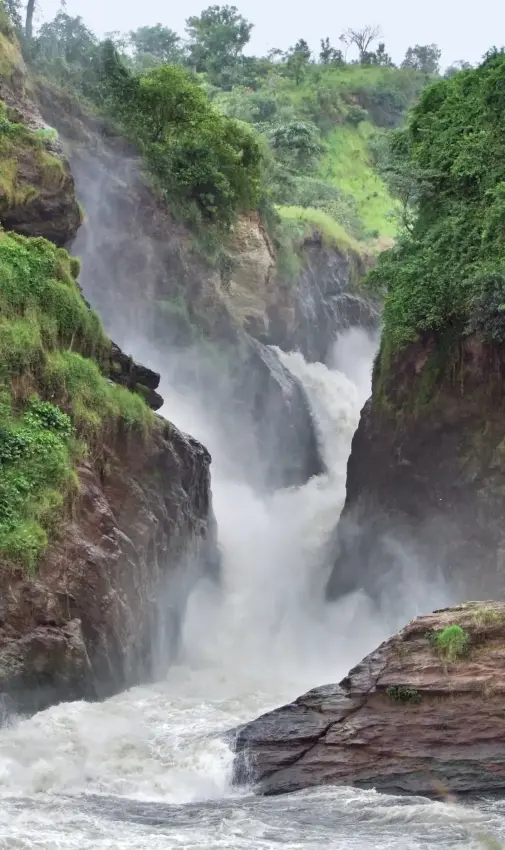
A Kibale Forest stay extends naturally south into Queen Elizabeth National Park, linked by the forest corridor, for savannah game drives and Kazinga Channel boat cruises, with the Ishasha sector known for tree-climbing lions. Bwindi Impenetrable National Park adds mountain gorilla tracking to the primate focus. The Rwenzori Mountains bring high-altitude trekking, while Semuliki National Park offers hot springs and Central African forest birds. Murchison Falls rounds out a wider Uganda itinerary with Nile scenery.





frequently asked questions
By light aircraft to Kasese, in about an hour and a quarter from Entebbe, then a short drive.
Scheduled and charter flights make the forest a straightforward add-on to a Ugandan route. The drive from Entebbe or Kampala is five to six hours, which some clients prefer for the scenery through the tea country.
From Kibale it is an easy transfer south to Queen Elizabeth National Park.
We book the flights with the rest of the trip and say plainly which leg is worth flying.
The most reliable chimpanzee tracking in Africa, and the numbers are why.
Kibale holds around fifteen hundred chimpanzees, with habituated communities that are found most mornings. A standard trek starts from Kanyanchu, takes two to four hours in total and gives you an hour with the group once you reach them.
The full-day habituation experience goes out with the researchers at dawn and stays until the chimpanzees nest.
Thirteen primate species live in the forest, so red colobus and grey-cheeked mangabey come as part of the morning.
Twelve for the standard trek, and fifteen for the full-day habituation experience.
The Uganda Wildlife Authority sets both and they are applied strictly at the briefing, so an eleven-year-old will not be allowed out however keen.
Younger children can stay at the lodge with a guide, and the Bigodi swamp walk nearby takes all ages and is genuinely good.
Tell us everyone's ages and we will build the morning so nobody is left with nothing to do.
Yes. Both TravelHealthPro, the UK's official travel health service, and the CDC treat Uganda as a malaria area and recommend antimalarial cover throughout the country.
Kibale sits at moderate altitude, which means fewer mosquitoes than the lowlands, but low risk is not the same as no risk.
We do not make medical recommendations. That is a conversation between you and your own doctor or a travel clinic.
On the practical side, cover up at dusk and carry repellent.
Rainforest kit, and a spare pair of socks.
- A waterproof jacket, and over-trousers if you have them
- Boots with grip, worn in, and gaiters for the mud
- Long sleeves and trousers in neutral colours, for the undergrowth
- A dry bag for a camera, because the forest is damp even between showers
Porters wait at the trailhead and are worth taking, both for the help and because it puts money into the villages around the park.
Binoculars matter here more than most places: much of what you want to see is overhead.
Two, and three if you want the habituation day as well.
Two nights gives you one tracking morning and an afternoon for the Bigodi swamp walk, which is the sensible minimum. A third night buys the full day with the researchers, or a second trek if the first was brief.
It sits naturally between Entebbe and Queen Elizabeth on a Ugandan route, and before the gorillas at Bwindi.
Tell us how much walking you want and we will build the days around it.
rated five stars by our clients

our approach
remote, exclusive
& personal
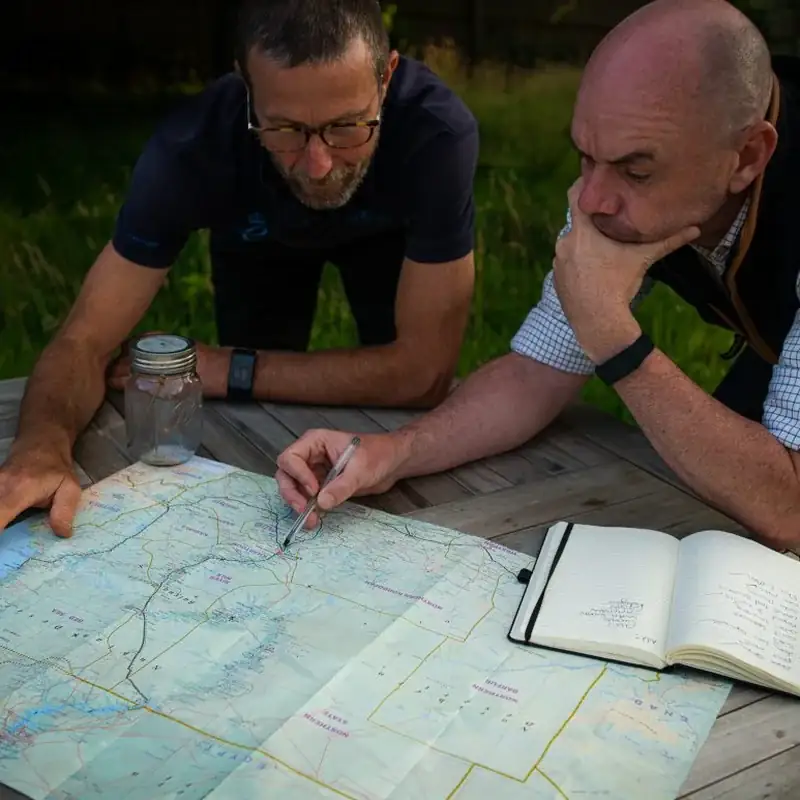
Every journey starts with a conversation. We take the time to understand your vision before we start planning.
Whether by phone or in person, we work with you directly to shape something that is considered, personal, and expertly delivered.
Every journey starts with a conversation. We favour a direct, personal approach: understanding your vision before anything else.
Whether by phone or in person, we work with you directly to shape a journey that is both thoughtfully considered and expertly delivered.
Get in touch to start planning yours.