
Lava-dammed lake of 29 islands
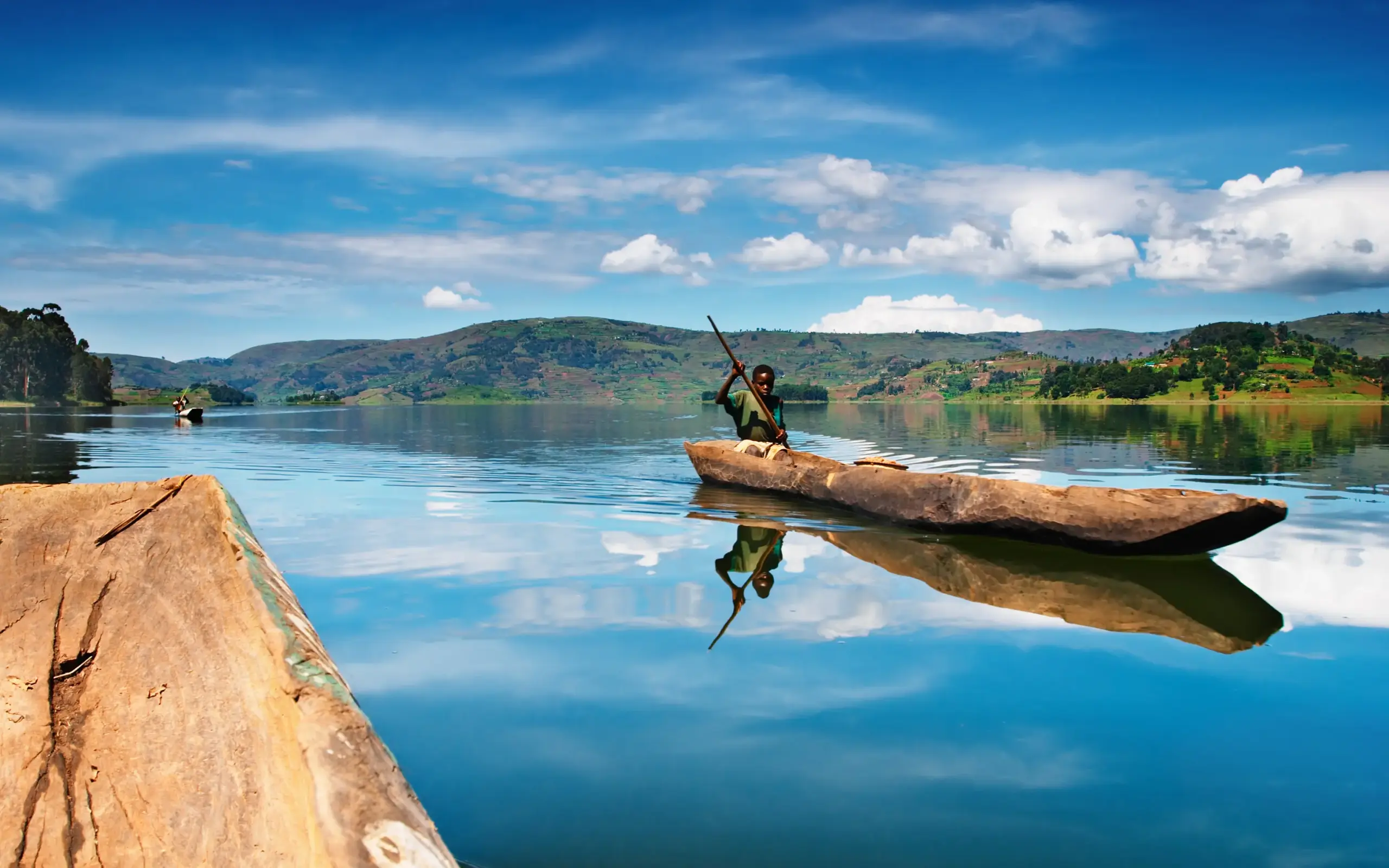
Lake Bunyonyi lies in the Kigezi highlands of southwestern Uganda, a deep freshwater lake fingered by 29 islands and ringed by hills terraced for crops over many generations. The air stays cool the year round in these highlands, and the water holds no hippos or crocodiles. The name means “place of many little birds,” and the birding lives up to it.
Fingered by 29 islands and ringed by hills terraced for crops
It was formed not by a crater, as is often assumed, but by lava. Flows from the nearby Rukiga Mountains dammed a river valley in the distant past. The lake sits within the Albertine Rift, the western arm of the East African Rift, which explains the steep, folded terrain that rises high above the water.

Birdlife is the headline draw, with over 200 recorded species. They move between the papyrus margins, the wooded islands and the cultivated slopes: grey crowned cranes, herons, weavers, kingfishers and sunbirds among them. Mammals are modest by savanna standards. African clawless and spotted-necked otters work the shoreline, and vervet monkeys appear in the surrounding forest.
Birdlife is the headline draw, with over 200 recorded species.
Each island carries its own history. Akampene, long known as Punishment Island, is tied to a harsh Bakiga custom in which unmarried pregnant girls were once abandoned there, a practice that endured into the early twentieth century. On Bwama, the English missionary Leonard Sharp founded a leprosy treatment community in 1931, settling himself on the smaller neighbouring island of Njuyeera.
The Bakiga have farmed these hills for centuries, and their terraces are the defining feature of the landscape, cut step by step to hold soil on slopes that would otherwise wash into the lake. The Batwa, forest peoples resettled here after leaving Bwindi and Mgahinga, form the area’s second community. Walking between homesteads, markets and small schools is the most direct way to understand how people live on this water-laced terrain, and it carries an everyday texture that lodge-bound visits rarely reach.
That network of villages and footpaths makes Lake Bunyonyi a natural base for multi-day community trekking. Rather than a single signposted route, the experience is built from village-to-village walking across the terraced ridges, overnighting in community guesthouses or pre-arranged camps, and crossing arms of the lake by dugout canoe. It suits travellers who would rather walk into daily life than observe it from a vehicle, and who value distance from the more trafficked stops on the southwestern loop.
Conservation runs through local hands rather than a park authority.
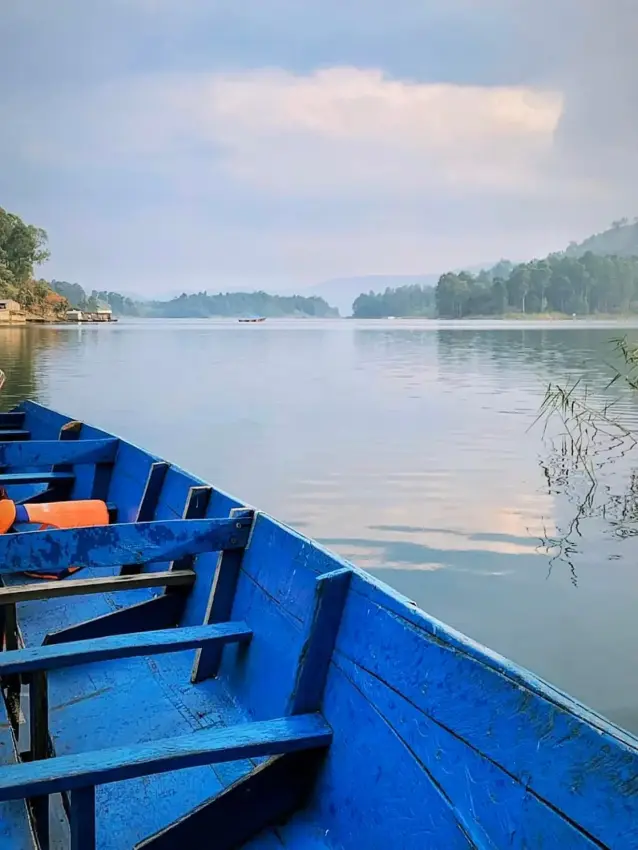
Position adds to the appeal. The lake sits close to the Rwandan border, around two to four hours by road from Kigali against eight to ten hours from Kampala, which makes it a logical, restful pause between the two countries. A few days here after the effort of gorilla trekking, before continuing a wider Uganda itinerary, makes structural sense. The cool climate and predator-free water encourage swimming and unhurried canoe days in a way few highland lakes allow.
Conservation runs through local hands rather than a park authority. The Lake Bunyonyi Community Organisation works on local conservation and community support, while the terraces themselves act as a centuries-old defence against the erosion that threatens to silt the water. The result is a landscape held together by the people who live in it, which is precisely what gives the place its quiet, lived-in character.
The best time to visit Lake Bunyonyi
Jan
Feb
Mar
Apr
May
Jun
Jul
Aug
Sep
Oct
Nov
Dec
Recommended
Transitional
Challenging conditions
For calm water and the easiest pairing with Bwindi gorilla trekking, come in the two dry seasons, June to September and December to February, for unhurried dugout-canoe trips and firmer forest trails next door. Birding is strong, with more than 200 species around the lake. The long rains of March to May are the wettest and turn the approach roads to mud. Temperatures stay mild all year.
accommodation in lake bunyonyi
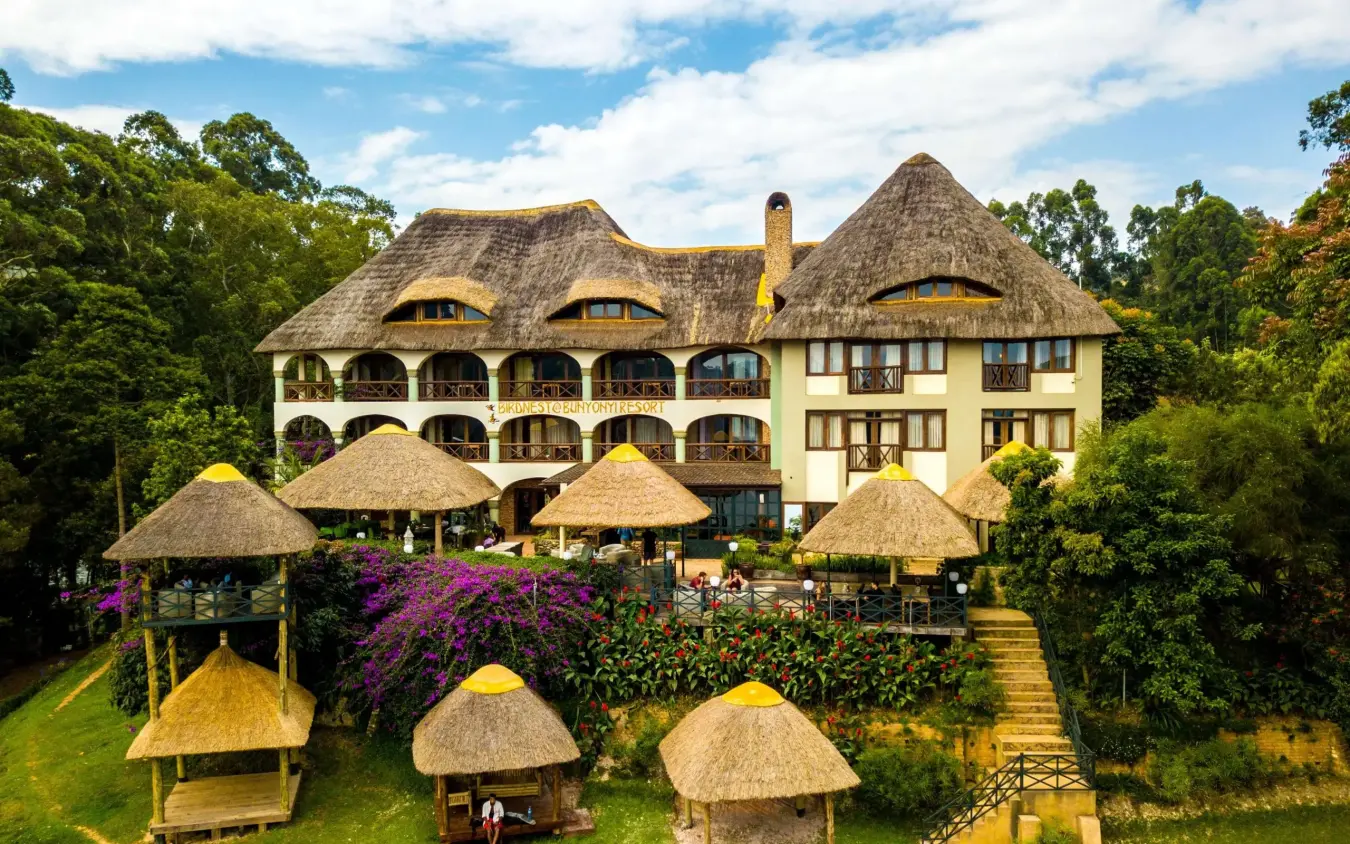
Stays range from island camps reached by canoe to hillside lodges with long views down the water, alongside eco-focused resorts, private cottages and safari-style tents on raised platforms. The character throughout is small-scale, low-density and built around the lake's calm. Several properties sit on the islands themselves, giving a sense of seclusion, while mainland lodges offer easier access for those linking the lake into a wider Uganda itinerary.


activities
Canoeing, terrace walks and birding
Dugout-canoe and motorboat trips reach all 29 islands, from short loops to full-day island-hopping. Guided hikes and mountain biking cross the terraced hills to Bakiga and Batwa communities, while birdwatching by boat takes in the papyrus margins. Swimming is possible in the predator-free water, and multi-day community treks link villages on foot.

conservation
Community-led lake and Batwa support
The Lake Bunyonyi Community Organisation runs a clean-lake campaign against siltation, promotes sustainable agriculture and eco-tourism, and supports the inclusion and rights of the Batwa community. The terraced farming maintained by the Bakiga is itself a long-standing safeguard against the soil erosion that threatens the lake.

getting around
Fly to Kisoro, drive in
Scheduled and charter flights run from Entebbe to Kisoro airstrip, with Aerolink Uganda and Bar Aviation serving the region, followed by a road transfer of one to two and a half hours. Kihihi airstrip is an alternative when combining with northern Bwindi. From Kigali, the drive is around two to four hours.
other areas in uganda
Lake Bunyonyi pairs naturally with Bwindi Impenetrable National Park for mountain gorilla trekking and Mgahinga Gorilla National Park for golden monkey tracking and Virunga volcano hikes, both within the southwestern highlands. Further afield, Kibale National Park offers chimpanzee tracking, Queen Elizabeth National Park adds savanna game viewing and the Kazinga Channel boat trip, and Lake Mburo provides a compact wildlife stop on the long road from Entebbe.





frequently asked questions
By road from Bwindi in about an hour and a half to two hours, or by light aircraft to Kisoro or Kihihi and then a drive.
The lake sits in the far south west near Kabale, so it is almost always reached from the gorillas rather than direct from Kampala, which is seven or eight hours away.
The road in climbs through terraced hills and is slow and beautiful.
We arrange the transfer with the trekking so the drive happens on the right day.
A private charter is the alternative to the scheduled seats, usually a Cessna Caravan, which is worth pricing for a party travelling together or a tight connection.
To rest after the gorillas, and it is the best place in Uganda to do it.
The lake is deep, quiet and ringed by steep terraced hills, with islands scattered across it. There are no hippo or crocodile, so swimming is straightforward, which is unusual in this part of Africa.
After a hard morning in the forest, a day in a dugout canoe with nothing to achieve is exactly right.
It is a rest stop rather than a wildlife destination, and we will describe it that way.
Yes. Both TravelHealthPro, the UK's official travel health service, and the CDC treat the whole of Uganda as a malaria area and recommend antimalarial cover countrywide.
The lake sits at around 1,950 metres, which means far fewer mosquitoes than the lowlands, but low risk is not the same as no risk.
We do not make medical recommendations. That is a conversation between you and your own doctor or a travel clinic.
On the practical side, cover up at dusk and carry repellent.
Gentle things, and deliberately so.
- A dugout canoe out to the islands, paddled yourself or by a guide
- Swimming from the jetties and the shore
- Walks through the terraced hills and the villages above the lake
- Birding, which is excellent along the shoreline and in the papyrus
A local guide can take you through the history of the islands, which is more interesting than it sounds.
Nothing here requires an early start, which is the whole point after a week of them.
Yes, and it is one of the few lakes in the region where that is true.
There are no hippo and no crocodile in Bunyonyi, which is why the local people swim in it and why the lodges have jetties and diving boards. The water is deep, clear and cool at nearly two thousand metres.
The lodges will say where the safe entries are.
Bring swimming things: most clients do not expect to need them in Uganda.
One or two, as the wind-down after the gorillas.
One night is a proper rest; two gives you a full day on the water and a walk in the hills. More than that and most people are ready to move on.
It sits naturally between Bwindi and the drive or flight back to Entebbe.
Tell us the whole route and we will say whether one night or two suits it.
rated five stars by our clients

our approach
remote, exclusive
& personal
Every journey starts with a conversation. We take the time to understand your vision before we start planning.
Whether by phone or in person, we work with you directly to shape something that is considered, personal, and expertly delivered.
Every journey starts with a conversation. We favour a direct, personal approach: understanding your vision before anything else.
Whether by phone or in person, we work with you directly to shape a journey that is both thoughtfully considered and expertly delivered.
Get in touch to start planning yours.