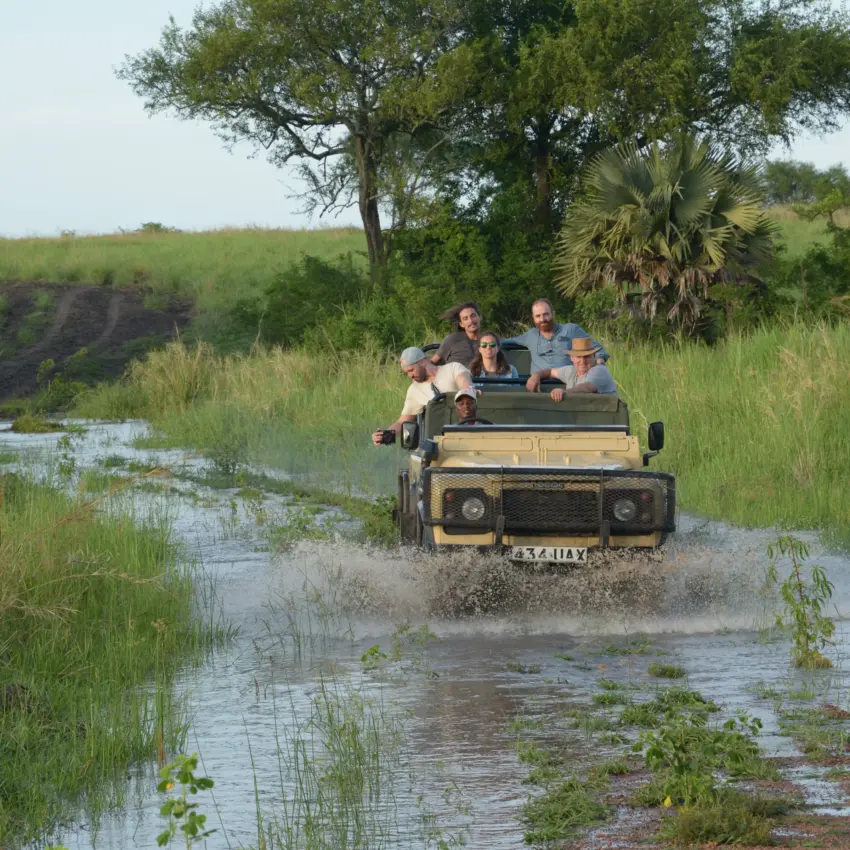
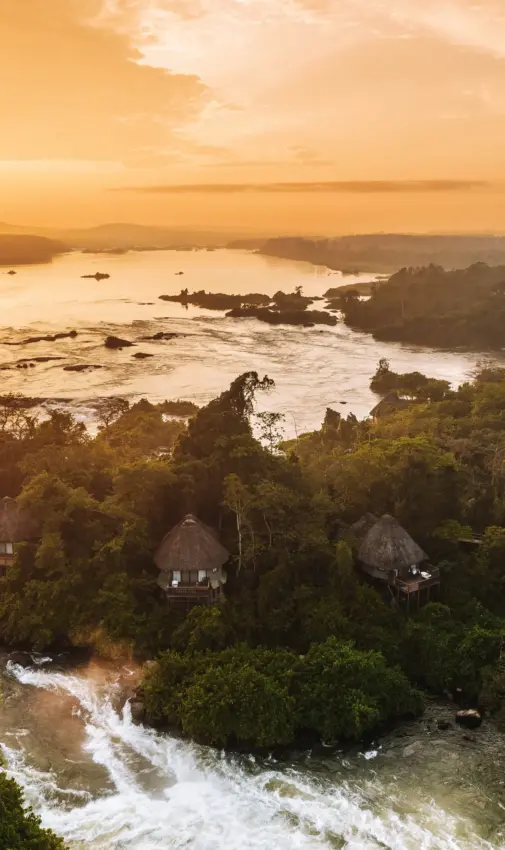
Below the escarpment, the reserve fills a stretch of the rift floor bounded by the Rwenzori foothills and Lake Albert. Here the grassland species of East Africa share ground with forest species from the Congo basin, and forest elephants range alongside savanna elephants. In the Mugiri canopy below the tents, black-and-white colobus feed among the branches, while giant forest hog keep to the thicker cover near the river. Game drives cross between the two worlds within a single morning, and guided walks follow the river forest on foot.
After dark, shared night drives go out with a spotlight, picking up genets along the track edges and owls on bare branches, while nightjars lift from the road ahead. On an early morning boat trip, guests go looking on Lake Albert for shoebill standing still in the shallows. Slate grey, with a broad bill shaped like a clog, it is easy to miss until it moves. The reserve lists more than 400 bird species, and the drive to the lake shore and back adds plenty of them to the day.
Slate grey, with a broad bill shaped like a clog, it is easy to miss until it moves.
The main lodge is timber under a high thatched roof, left open on one side. Inside, polished floors run beneath hand-carved tables through the lounge, the library and the bar. A pool looks out over the forest. Dinner runs to three courses by candlelight, built around the lodge’s own organic garden and produce from nearby farms. Several hundred metres away, the foundations of the reserve’s earlier lodge, a favourite in the 1950s and 1960s, now serve as staff housing.
The road down to the valley floor was once a narrow dirt track. Private charters land at the Semliki airstrip, which removes the road journey altogether. Kibale Forest pairs naturally with the Semliki Valley, setting forest primate country beside open rift grassland and its dry-country chimpanzees. Semliki Safari Lodge covers the open-country half of that journey, from the kob plains to the lake shore where the shoebill wait.