
Fog on 180 days, rain under 20 mm
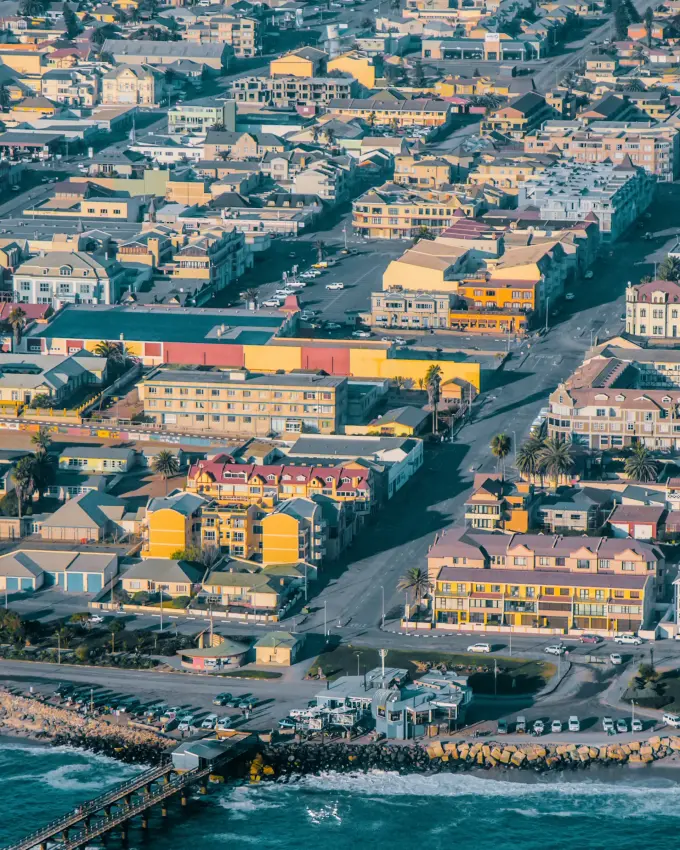
Swakopmund sits where the Swakop River meets the Atlantic, its palm-lined streets and Wilhelmine facades enclosed on three landward sides by the Namib. Cold surf and dune begin at the edge of town. Sea fog arrives most mornings, pulled in by the cold Benguela Current, and usually lifts by midday. Rainfall is under 20 mm a year, so the fog does the work rain would do elsewhere.
Quad bikes climb the dune belt that starts at the last street.
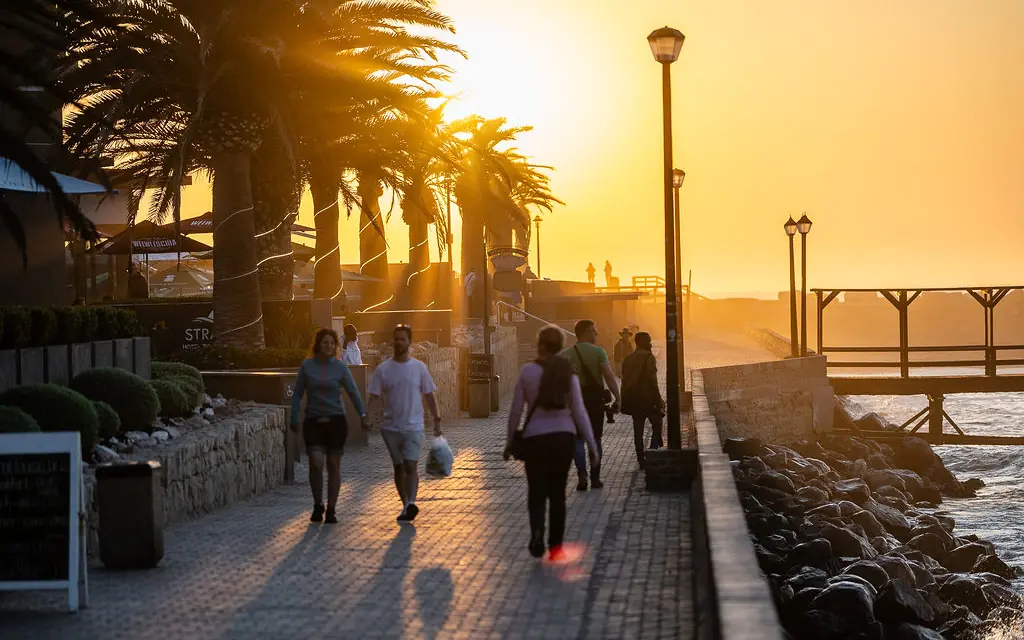
Bakeries and cafes open along the seafront promenade, and the fog has usually burned off the sand by mid-morning. Quad bikes climb the dune belt that starts at the last street, and sandboarders ride the same slopes. Catamarans leave the Walvis Bay lagoon for Heaviside’s dolphins and Cape fur seals, while light aircraft head north over the Skeleton Coast wrecks. It is Namibia’s main coastal adventure base.
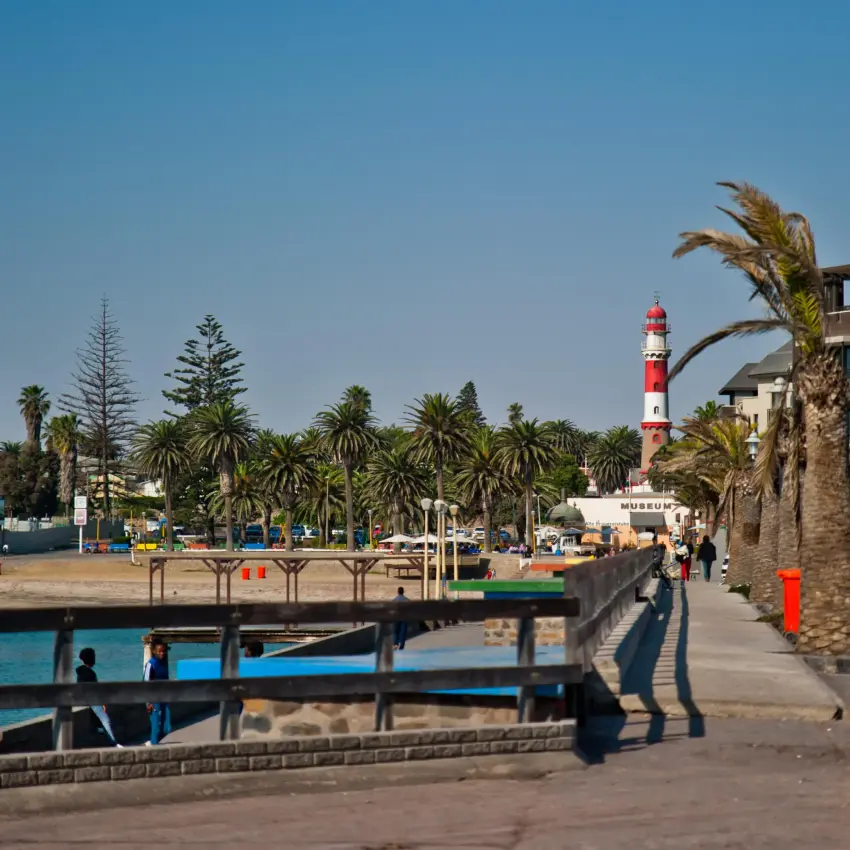
Curt von François founded the town in August 1892, after Walvis Bay’s deep-water harbour fell under British control and German South West Africa needed a port of its own. The Mole, an attempt at an artificial harbour, never worked. What survives instead is the architecture: the 1905 Woermannhaus and its Damara Tower, a prison of 1909, and the lighthouse of 1902.
Volunteers still tend the unmarked graves of that camp.
The harbour’s later expansion and operation and the Otavi railway relied on Ovaherero and Nama prisoners held here after the 1904 uprising, in a camp where most died of disease, exposure and hunger. Volunteers still tend the unmarked graves of that camp, and the Swakopmund Genocide Museum keeps the record. The Scientific Society runs the town museum and the Sam Cohen Library, with its documents, maps and photographs.
Fog rolls in on more than 180 days of the year, formed when cold water pushed north by the Benguela Current chills the air above the Atlantic and drives advection fog inland over the desert. Lichen fields survive on fog alone and take decades to recover from one tyre track, rootless carpets spread across the gravel north of town. On the plains along the Swakop River, Welwitschia mirabilis grows slowly enough that a single plant outlasts a millennium, keeping company with pencil bush and dollar bush.
Swakopmund is ringed by Dorob National Park, proclaimed in December 2010 as a multiple-use park under Namibia’s environment ministry. The designation permits quad biking, sandboarding and 4×4 routes, but confines them to the dune belt running south towards Walvis Bay. Driving on the gravel plains is prohibited outright, and the lichen beds and Damara tern breeding grounds are closed to vehicles and walkers alike without a scientific permit. Sandwich Harbour, further south in the Namib-Naukluft park, needs a registered guide and a permit of its own.
Lichen fields survive on fog alone and take decades to recover from one tyre track.
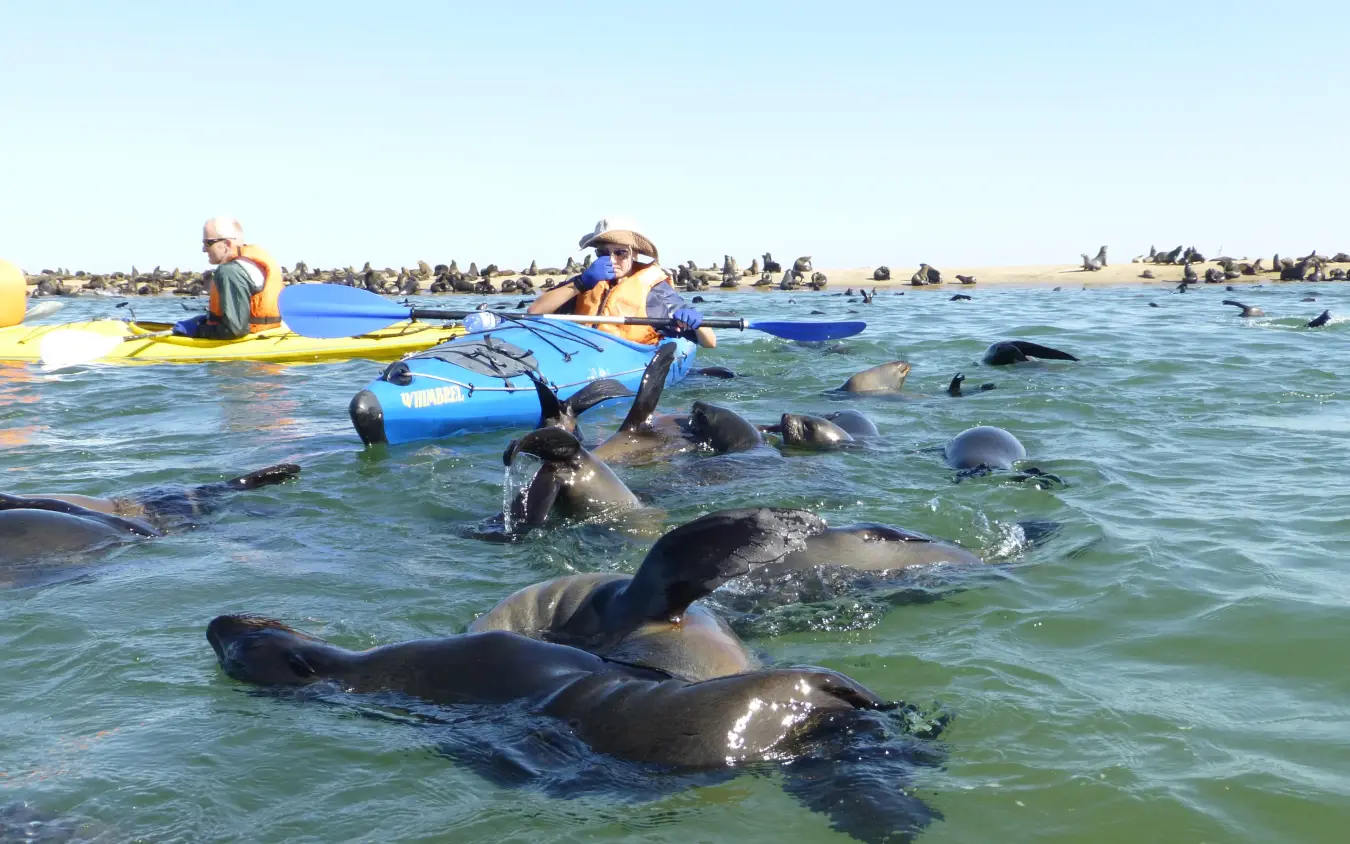
Catamarans out of the Walvis Bay lagoon, a RAMSAR wetland roughly 35 km south, work the water where the upwelling gathers Heaviside’s dolphins, bottlenose dolphins, sunfish and Cape fur seals, with humpback and southern right whales passing between July and November. Greater and lesser flamingos crowd the shallows through winter, then leave for the Etosha Pan when inland rain falls. Further up the coast, the Cape Cross seal colony, 120 km north, holds a breeding population in the tens of thousands, patrolled by black-backed jackals and brown hyenas.
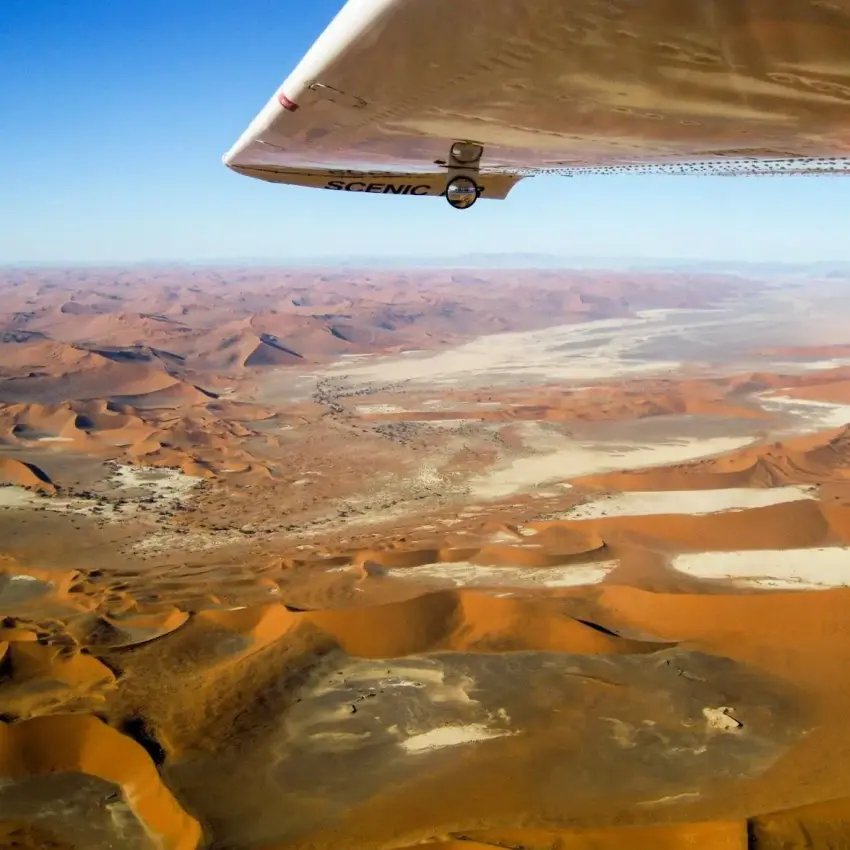
North of the Swakop mouth the Skeleton Coast begins, and the most direct way in is by air. Light aircraft and helicopters lift off from the town’s airfield and follow the shore over wrecks, among them the Eduard Bohlen, half-buried in sand well back from the water. The same flights cross the dune sea south to Sandwich Harbour, where the Namib’s dunes drop straight into the Atlantic. Inland, on a ministry permit, the Welwitschia Drive crosses the eroded Moon Landscape along the Swakop River.
The best time to visit Swakopmund
Jan
Feb
Mar
Apr
May
Jun
Jul
Aug
Sep
Oct
Nov
Dec
Recommended
Transitional
Challenging conditions
Come June to September for cooler, stable conditions and easy pairing with inland safari, when foggy mornings lend the Skeleton Coast real drama. Summer (Nov-Feb) brings warmer, brighter days for sea-based activity, though inland heat can be intense and wind and fog vary. In truth, this is a year-round destination.
accommodation in swakopmund
Everything here is built rather than canvas, and there are no tented camps. Grand seafront hotels include a long-established hotel and a large resort out on the Mole, while boutique guesthouses in the quiet Vineta streets keep balconies over the beach. Wooden chalets on stilts stand above the Swakop river mouth, good for birdwatching, and private beach villas along the Vineta coast take exclusive-use bookings.


activities
Dune riding, dolphins and wrecks
Quad biking and sandboarding run only on the designated dune belt between Swakopmund and Walvis Bay. Marine cruises leave from the Walvis Bay lagoon, Sandwich Harbour requires a registered 4x4 operator, and scenic flights and helicopters cover the Skeleton Coast and dune sea. Historical walking tours cover the town centre.

conservation
Lichen, terns and beach cleanups
The Naankuse Foundation's coastal project near Long Beach monitors wildlife, frees entangled seals and clears rubbish from the shore with volunteers. Fenced tern nesting sites have stabilised Damara tern numbers, and TOSCO channels tourism revenue into desert carnivore research and conflict mitigation.

getting around
Fly Walvis Bay, drive north
Walvis Bay International, to the south, takes Airlink flights from Johannesburg and Cape Town and FlyNamibia from Windhoek, with a short road transfer up the coast. Swakopmund's own airfield handles private charters and helicopters, and serves as the departure point for coastal scenic flights. The tarred B2 links Windhoek in roughly four hours.
other areas in namibia
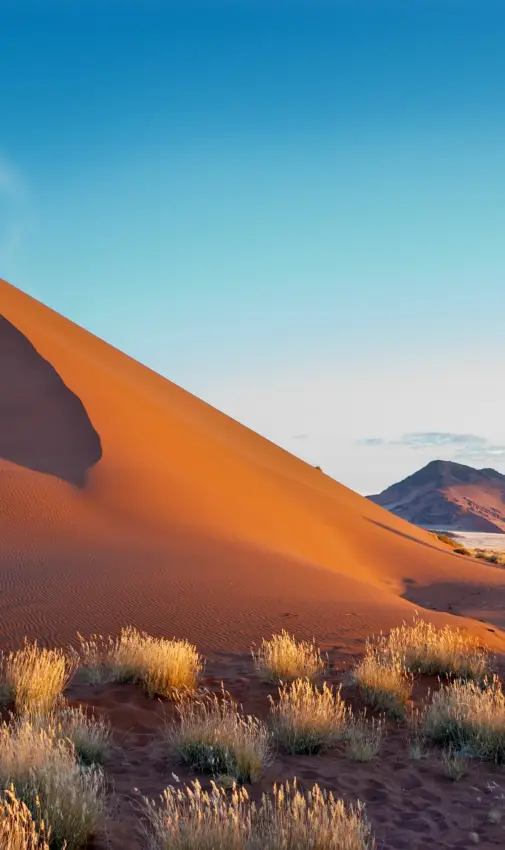
Sossusvlei, in the Namib-Naukluft, holds red dunes and the clay pan of Deadvlei, reached by charter from the coast or the gravel C14 through the Kuiseb Canyon. Skeleton Coast National Park runs north toward Angola, its wrecks and seal colonies served by fly-in camps. Damaraland has flat-topped mountains, the rock engravings at Twyfelfontein, desert-adapted elephants and black rhinos. Etosha, roughly seven hours by road, gathers big game around its salt pan in the dry season.
 01
01
 02
02
 03
03
 04
04
 05
05
 06
06
 07
07
 08
08
frequently asked questions
By road from Windhoek in about four hours, or by light aircraft to the airport just outside town.
The drive crosses the desert on good tarmac and is a genuinely interesting day, particularly the last stretch where the dunes meet the sea. From Sossusvlei it is five to six hours, and most self-drive routes take it.
Flying is quick and the descent over the coast is worth the fare.
We book whichever suits the wider route and build the connecting leg in where it helps.
If the scheduled days do not suit, a private charter from Windhoek goes when you want, a Cessna Caravan or a Pilatus PC-12, and we quote both.
More than anywhere else on the Namibian coast, and it is the country's activity town.
- Sandwich Harbour by four-wheel drive, where the dunes drop into the Atlantic
- Kayaking with the seal colony at Pelican Point, and the catamaran cruises
- Quad biking, sandboarding and skydiving over the dunes
- A living desert tour, for the chameleons, geckos and sidewinders
The town itself is a strange, pleasant piece of German colonial architecture with good coffee and better cake.
We book the activities before you arrive, because the good operators fill up.
The Benguela current, which chills the air before it reaches the land.
The sea here is genuinely cold year round and the fog rolls in most mornings, so the town is cool and grey when the desert an hour inland is hot. Visitors regularly arrive with only shorts and regret it.
The fog usually clears by the middle of the day.
Pack a fleece and a windproof for the coast alongside the light clothes for everywhere else in Namibia.
The coast is cold, foggy and dry, and it sits well outside the regions that TravelHealthPro, the UK's official travel health service, and the CDC name as Namibia's malaria areas.
That is not the same as a malaria-free trip: a route that continues north to Etosha, the Kunene or the Zambezi region enters real seasonal risk.
We do not make medical recommendations. That is a conversation between you and your own doctor or a travel clinic.
On the practical side, cover up at dusk once you are north.
It is the easiest stop in Namibia for them.
The activities suit teenagers particularly well, the town is walkable, there are restaurants rather than set dinner times, and after a week of long desert drives everybody appreciates a change of pace.
Ages matter for the adventure sports, and the sea is too cold and rough for swimming.
Tell us their ages and we will book the activities that actually take them rather than leaving you to find out at the desk.
Two, and three if you want more than one big activity day.
Two nights gives you a full day for Sandwich Harbour or the kayaking, plus an evening in town. Three lets you do both without cramming.
It sits naturally between Sossusvlei and Damaraland on a Namibian route, and it is the one place where the pace can drop.
Tell us the route and we will say how many nights it earns.
rated five stars by our clients

our approach
remote, exclusive
& personal
Every journey starts with a conversation. We take the time to understand your vision before we start planning.
Whether by phone or in person, we work with you directly to shape something that is considered, personal, and expertly delivered.
Every journey starts with a conversation. We favour a direct, personal approach: understanding your vision before anything else.
Whether by phone or in person, we work with you directly to shape a journey that is both thoughtfully considered and expertly delivered.
Get in touch to start planning yours.