Timing your trip
best time to visit victoria falls
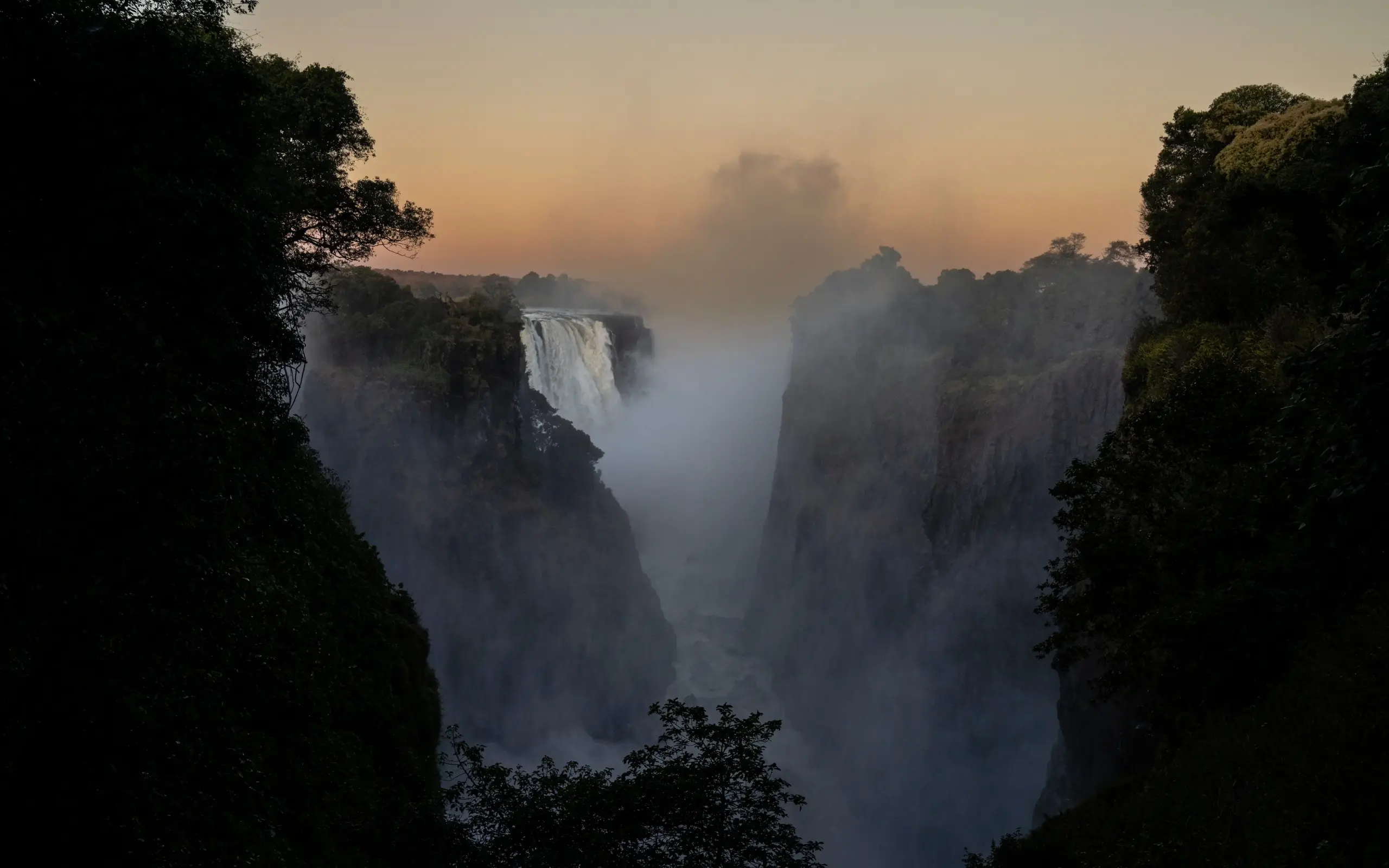
The Zambezi swings between flood and trickle across the year, and the falls you see in April are not the falls you see in October. When you come decides whether you get the full curtain of water, the bare rock face and clear dry-season game, or the green months in between.
seasonal guide to victoria falls
For the combination most visitors want, clear falls views, dry-season game on the Zambezi and the activities at their best, come between June and September. Devil's Pool opens around mid-August and low-water rafting builds as the river drops. September and October bring the heaviest heat. April and May deliver maximum flow, though spray hides the view; December to March is green, hot and wet.
month by month details
January sits in the middle of the rainy season, with thick bush, scattered water and dispersed wildlife. Afternoon thunderstorms are frequent and humidity is high, with daytime temperatures into the low 30s.
The Zambezi is rising on upstream rains, so the falls are growing in power and spray is increasing. Game viewing in Zambezi National Park is at its weakest, animals have water everywhere and stay spread out through dense vegetation, though birding is good as migrants are present. Devil's Pool is closed and high-water rafting is limited. This is a month for green-season atmosphere rather than wildlife or clear falls views.
February brings the river toward peak volume and one of the most powerful displays of water of the year. The trade-off is heavy spray that soaks viewpoints and obscures wide views of the curtain.
Rains and humidity continue, with warm nights and frequent electrical storms. Wildlife stays dispersed in thick green bush, so game viewing remains poor, though birding is at its best. Devil's Pool is closed and rafting is restricted or shut as the river runs too high. Come now for raw power and rainbows, not for clear photographs or safari.
March often delivers the peak flood, with the full width of the falls running at maximum volume. Mist remains heavy and you should expect to get wet at the viewpoints, though visibility starts to improve slightly toward month end.
Rainfall begins to taper but storms are still likely, and the bush remains lush. Game viewing is improving as the wettest period passes, but it is not yet at dry-season quality, animals stay fairly spread out. Rafting is generally still closed at these water levels. This is the month for the falls at their most thunderous, with safari a secondary consideration.
April frequently marks the highest annual flow, the falls a single roaring curtain across their full span. Spray is intense and constant, throwing rainbows but limiting how much of the falls you can see from the ground.
The rains have ended, humidity is dropping and days are pleasantly warm, cooling in the evenings. Vegetation is still thick, so while game viewing is improving as the dry season approaches, animals have not yet concentrated on the river.
Rafting remains closed at flood levels. April suits those who want the spectacle at its fullest and will trade clear views and prime game for it. A helicopter flight is the way to take in the scale.
May opens the dry season while the falls still run high, a strong balance of power and improving visibility. Spray is easing from the flood months, so more of the curtain comes into view, and the weather turns cool, clear and comfortable.
This is the start of the better game viewing in Zambezi National Park as vegetation thins and animals begin to gather along the river. River cruises are at their best in the cool, settled evenings. Rafting is still closed or limited as levels remain high, and Devil's Pool stays shut. A good all-round month for anyone wanting both a full-ish falls and the start of the safari season.
June settles into the dry winter, with prime game viewing underway and the falls still carrying substantial flow. Spray has reduced enough to see the falls clearly while the river remains impressive, a rare combination of water and visibility.
The bush is thinning and water sources are shrinking, so wildlife concentrates along the Zambezi and at waterholes, and sightings are strong. Days are mild, around the mid-20s, but nights turn cold, sometimes near 10 degrees, so pack warm layers for early game drives and cruises.
The river is still too high for the low-water rafting season, which opens from August. This is one of the best months for a combined falls and wildlife trip.
July is the heart of the dry season, with top game viewing, clear falls views and the river at a balanced medium level. Spray is much reduced, so you see both the falling water and the gorge, and photography is at its best.
Animals depend on the few remaining water sources, concentrating game along the river in Zambezi National Park, particularly elephant. The river is dropping toward the low-water rafting season, which opens from August. This is the coldest month, with comfortable days around the mid-20s but nights dropping to 7 to 10 degrees, so warm clothing is essential at dawn and dusk. An excellent all-round choice.
August holds peak dry-season game viewing and brings the falls' rock face into clear view as water levels drop. Devil's Pool, on the Zambian rim, usually opens around mid-month, and low-water rafting opens on the exposed rapids.
Wildlife sightings are excellent with animals tied to the river, and elephant numbers are high. Spray is minimal, ideal for photography and for seeing the geology of the gorge, though the sheer volume of water is well below the flood months. Days warm into the high 20s while nights stay cool. A strong month for combining clear falls, swimming on the edge, rafting and safari.
September brings outstanding game viewing as the dry season intensifies and water becomes scarce. The falls run low, the rock face is exposed and Devil's Pool, Livingstone Island and low-water rafting are all in full swing.
Animals crowd the remaining water, making for some of the best wildlife of the year, especially large elephant concentrations. The trade-off is heat, days climb well into the 30s, and the falls are reduced to fewer channels, more about geology than volume.
Anyone set on the full curtain of water should look to April instead. For wildlife, activities and clear views, this is a prime month for those who tolerate heat.
October delivers the year's best wildlife concentrations alongside its lowest water and most punishing heat. Temperatures regularly exceed 35 degrees and can reach 40, which is the reason it falls short of a clear recommendation despite excellent game.
Animals are drawn to the last water, so elephant and general sightings are at their height, and rafting, Devil's Pool and Livingstone Island are all open. The falls, however, are at their thinnest, with large sections of bare rock and little spray, so this is not the month for the water spectacle. Best for those who prioritise wildlife and adventure and can handle the intense heat.
November is the turn of the season, the first rains breaking the heat as the falls sit low and begin to rise. Game viewing is still good early in the month but eases as showers green the bush and animals start to disperse.
Afternoon thunderstorms become more frequent and the landscape begins to recover, while days stay hot and humid. Low-water rafting and Devil's Pool generally remain open through much of the month before levels climb. A reasonable shoulder month with fewer crowds, mixing residual dry-season wildlife, rafting and the first green of the new season, but conditions shift quickly.
December settles into the wet season, with the bush greening, wildlife dispersing and the falls rebuilding power. Frequent storms, heat and humidity define the month, and game viewing is well below the dry-season peak as water becomes widespread again.
The river rises and spray increases, with the falls regaining strength, though not yet at flood. This is among the last of the good low-water rafting before the river closes the runs, and birding is excellent as migrants arrive. Devil's Pool typically closes as levels climb. A green-season month for atmosphere and landscape rather than wildlife or clear falls.
Plan your perfect zimbabwe safari
Tell us a little about what you have in mind and one of our specialists will be in touch.
frequently asked questions
They are two different sights, and the answer depends on what you came for.
High water, from about March to May, is the Falls at full power: a wall of spray, the far side invisible, everyone soaked on the rainforest path. Magnificent, and hard to photograph from the ground.
Low water, from about September to December, exposes the black basalt face, clears the mist and lets you see the shape of the gorge. It is the photographer's season, and the one that opens Devil's Pool and the classic rafting.
June to August sits between the two, which is why it is the busiest. For a first visit, we would send you then or in September.
Roughly mid-August to mid-January, and it books out further ahead than anything else in town.
The pool is a rock lip on the Zambian side at Livingstone Island, and it only works when the river has dropped enough to be safe. Groups are small, the season is short, and the slots go months in advance.
Rafting follows a similar rhythm: the classic low-water run operates from about August to December and stops altogether at peak flood in April and May.
If either is the reason for your trip, tell us before we set the dates rather than after.
June to September, and it is the reason to give the area more than two nights.
The Zambezi valley dries through the winter, the game concentrates on the river and the pans, and the days are clear and cool. September is outstanding: the water is low, the game is at its most concentrated and every activity is running.
October is the hottest month of the year here, superb for animals at water but punishing in the middle of the day.
From December to February the rains disperse the game and the Falls rebuild. That is the season to come for the waterfall rather than the wildlife.
Hotter and colder than the pictures suggest.
October and November are the fierce months, well into the thirties and humid before the rains break. June and July are the other extreme: warm, clear days and genuinely cold dawns, so an open vehicle or a boat at first light wants a jacket, a hat and gloves.
The rainforest path is its own climate. When the river is high you will be soaked whatever the temperature, so a light waterproof earns its place from about February to June.
Pack layers, neutral colours for the bush days, and something you do not mind getting wet.
It is the weakest month, and we will say so.
The wet season returns, the game disperses into thick green bush, the humidity builds and the Falls are still rebuilding from their low point. The rafting is finishing and the light is heavy.
What it has is price, space and thunderstorms over the gorge, which are a sight in themselves.
If your dates are fixed in December we will build the trip around the water-based activities and the game reserves rather than the Falls alone. If they are not, move a fortnight either side and you have a better week.
Six to nine months for the peak, and longer if Devil's Pool matters.
June to September fills first, because it is the dry-season window for the whole region and Victoria Falls is where most southern African trips start or finish. The good river-facing rooms and the small lodges go early.
Devil's Pool, the helicopter slots and the best guides are the things that run out rather than the beds.
If you are inside three months for August, tell us and we will be honest about what is left rather than selling you the remainder.
rated five stars by our clients

our approach
remote, exclusive
& personal
Every journey starts with a conversation. We take the time to understand your vision before we start planning.
Whether by phone or in person, we work with you directly to shape something that is considered, personal, and expertly delivered.
Every journey starts with a conversation. We favour a direct, personal approach: understanding your vision before anything else.
Whether by phone or in person, we work with you directly to shape a journey that is both thoughtfully considered and expertly delivered.
Get in touch to start planning yours.